AI is rapidly expanding into intelligent driving, low-altitude perception, smart transportation, industrial sensing, and many other fields.
For AI radar, hardware performance continues to improve and algorithm models continue to evolve. Yet once systems are deployed in vehicles and complex real-world environments, the industry faces a common challenge:
Real-world performance often falls short of test results, algorithms become increasingly rigid, and adaptability to new scenarios weakens over time.
The root cause is that many teams have focused on the first half of the journey — algorithm deployment — while lacking the second half: continuous iteration through a closed loop of data and training.
The core competitiveness of AI radar is not the accuracy of a single model, but the ability to keep data flowing, models evolving, and perception adapting continuously to real-world scenarios.
At its core, AI radar is a data-driven perception system that continuously evolves.
A complete data closed loop typically includes:
Real-World Data Collection → Data Cleaning → Automated Annotation → Model Training → Model Deployment → Real-World Validation (Automated Evaluation) → Data Re-collection and Optimization
Much like an experienced driver improves by continuously accumulating experience and learning from mistakes, an AI radar data closed loop gives algorithms the ability to keep learning from real-world operation.
Only through continuous data flow and model iteration can AI radar truly adapt to complex environments and become smarter over time.
Building on years of automotive millimeter-wave radar R&D and large-scale production experience, Cheng-Tech has established a comprehensive data closed-loop system for AI radar.
The Cheng-Tech “Xingliu” Data Closed-Loop System connects data collection, cleaning, automated annotation, model training, deployment validation, automated evaluation, and continuous optimization, turning radar data into a valuable asset that continuously improves AI capabilities.
Its core capabilities include:
Improving AI models fundamentally depends on large volumes of high-quality data.
In real-world applications, manual frame-by-frame annotation is costly and inefficient, making it difficult to support rapid model iteration.
The Xingliu system combines the basic parsing capabilities of conventional radar perception algorithms, active learning strategies from AI models, and reference information from high-precision ground-truth systems to enable automated radar data annotation and high-quality sample generation.
This moves AI training from small-scale manual experience toward large-scale, data-driven learning.
Real-world road environments are far more complex than laboratory conditions.
The same object may present very different perception characteristics under different weather, lighting, and road conditions.
For example:
standing water on rainy roads may generate additional reflections;
low-light conditions at night reduce visual target features;
high-speed driving introduces more complex motion-related data changes;
dense traffic and complex backgrounds in urban environments increase recognition difficulty.
AI radar therefore cannot rely on one-time training to cover all scenarios. It must continue learning.
By continuously accumulating real-world driving data, the Xingliu system supports ongoing fine-tuning and iterative training of core AI radar algorithms, including object detection, classification, interference suppression, and noise reduction, enabling stable perception across increasingly complex operating conditions.
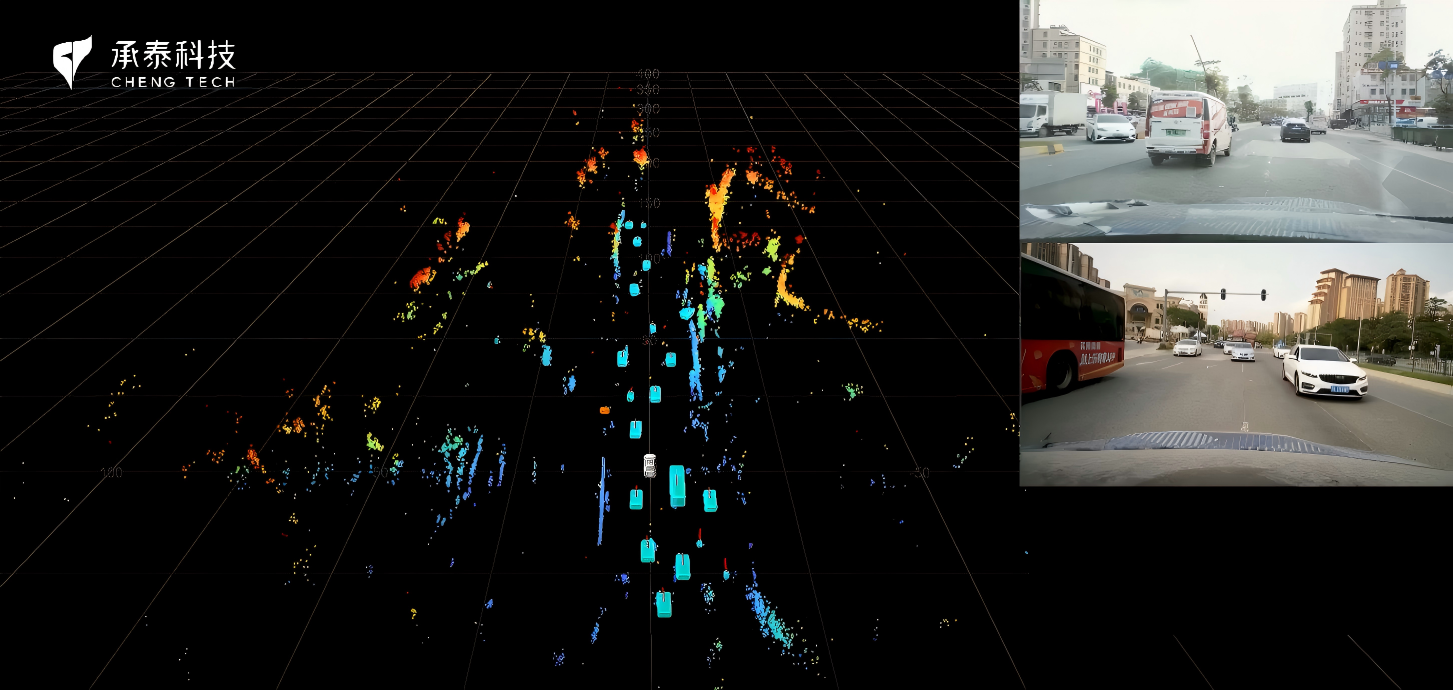
Scenario Example: Dense Targets and Complex Backgrounds in Urban Environments
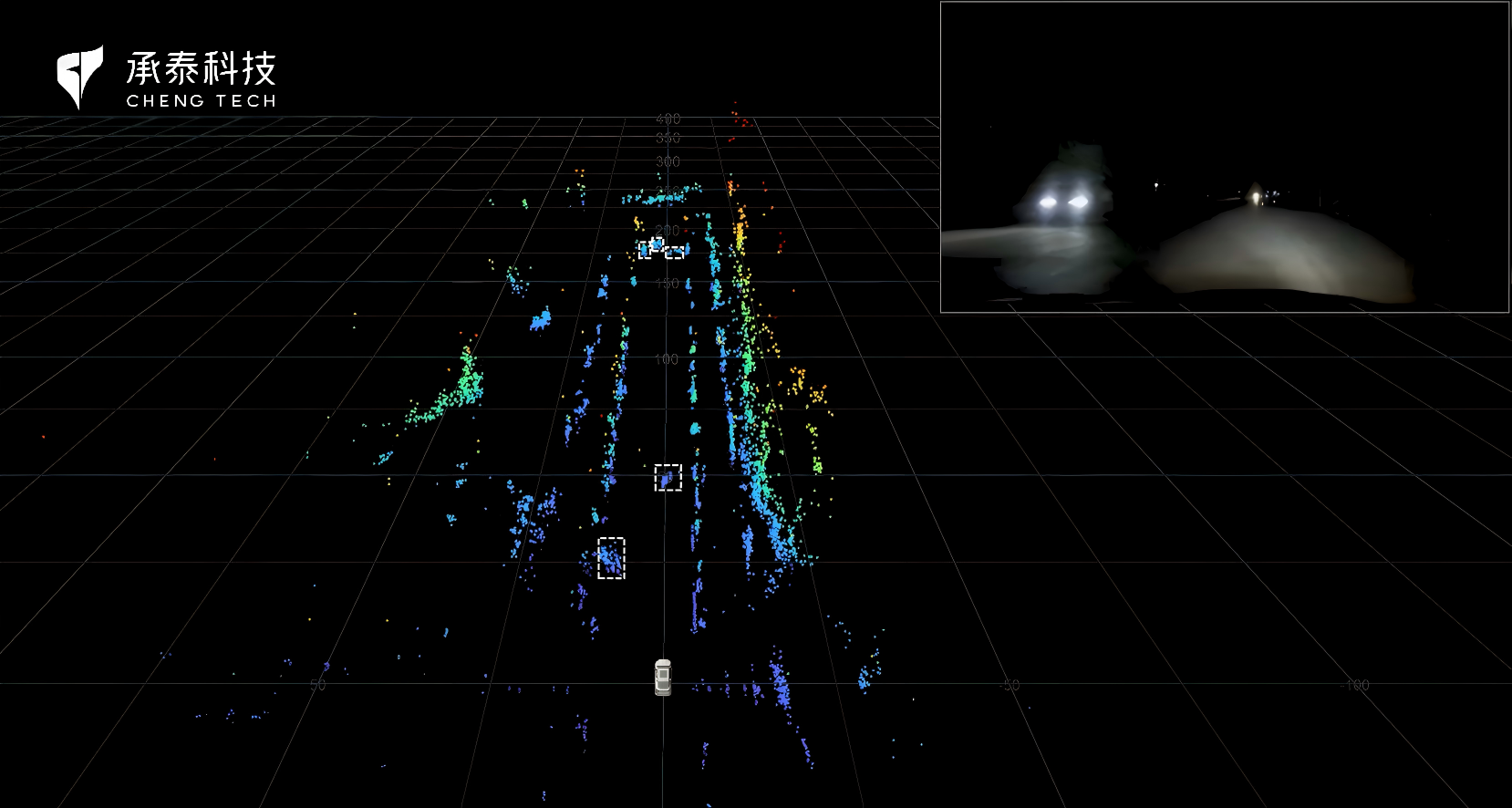
Scenario Example: Low-Light Conditions on Suburban Roads at Night
Moving AI models from the lab into real-world applications requires efficient and reliable engineering deployment.
After model iteration and optimization, the Xingliu system uses model compression, inference optimization, and deployment acceleration technologies to rapidly adapt AI algorithms to edge computing platforms, enabling low-latency and highly reliable operation.
At the same time, online performance monitoring and system-status analysis continuously track key indicators such as object detection, classification, and interference suppression, helping ensure stable model performance in real-world environments.
How do we know whether an AI model has truly improved? Training alone is not enough — scientific evaluation is equally important.
Cheng-Tech’s automated radar point-cloud evaluation system uses high-precision ground-truth data to assess point-cloud quantity and quality within defined areas around target objects. It evaluates key indicators including point-cloud geometry, spatial distribution, and radar echo quality, enabling one-click automated assessment.
It works much like reviewing mistakes after an exam: the system does not just provide a score, but also helps identify where the problems are.
With automated evaluation, algorithm optimization moves from experience-based judgment to a data-driven process.
Through continuous data feedback, model training, and performance validation, AI radar can support highly efficient algorithm iteration and continuously improve object detection, classification, tracking, and interference suppression.
This enables radar models to be upgraded with lower cost and higher efficiency, while continuously improving perception performance in complex scenarios.
Under traditional development models, a single algorithm upgrade may require multiple stages, including data collection, manual annotation, model training, and field validation, resulting in long development cycles and high costs.
With an automated data closed loop, data can be rapidly fed back into the system, automatically annotated and evaluated, and continuously used for training, significantly shortening model iteration cycles and accelerating algorithm optimization and product upgrades.
When AI radar is deployed in new roads, industrial parks, airports, ports, or low-altitude scenarios, there is no need to rebuild an entirely new data system from scratch.
Instead, a unified data closed-loop platform can continuously accumulate and reuse data assets, allowing algorithms to adapt rapidly to different business scenarios, reducing project delivery risks, and improving scalability across deployments.
As projects continue to operate, real-world data accumulates across different scenarios, target types, and operating conditions, forming proprietary data assets.
These data assets not only drive continuous improvement of AI radar, but also provide long-term support for future algorithm upgrades, multi-sensor fusion, and intelligent driving applications, creating a core competitive advantage that is difficult to replicate.
In the AI era, radar competition is entering a new stage.
Hardware performance defines the sensing foundation. Algorithm capability determines initial performance. But the data closed loop determines how far the system can evolve over time.
The AI radar of the future will not simply be a sensor that outputs target information. It will become intelligent perception infrastructure capable of continuous learning and continuous optimization.
Cheng-Tech will continue to build its AI perception technology stack and use data closed-loop capabilities to advance millimeter-wave radar from perception to cognition, supporting the large-scale deployment of intelligent driving and a broader range of intelligent applications.
MAILBOX:
CT@chengtech.net
 Shenzhen company
ADD: 3F-5F, Building C, Chengtou Zhiyuan, No. 37, Cuijing Road, Pingshan District, Shenzhen City
TEL: 0755-23215221
Suzhou company
ADD: No. 7, Suyang Road, Huangdai Town, Xiangcheng District, Suzhou City
TEL: 0512-68359858