In the era of end-to-end intelligent driving, millimeter-wave radar is being redefined.
For the past decade, radar has largely answered the same questions: Is there an object ahead? How far away is it? How fast is it moving?
But in the era of end-to-end driving, foundation models are asking a different question:
What is actually happening in the physical world?
As intelligent driving increasingly relies on massive volumes of data to learn environmental patterns, the object lists traditionally output by radar are no longer sufficient.
We need to rethink what kind of radar foundation models actually need.
In conventional distributed architectures, most radar processing is completed at the edge.
Starting from RF signal acquisition, radar typically performs range estimation, Doppler processing, angle estimation, target clustering, and other processing steps before sending an Object List or limited target-level information to the domain controller.
This architecture offers advantages such as low communication bandwidth and simple system deployment in conventional ADAS applications. But for end-to-end driving systems, it also introduces clear limitations.
After multiple layers of feature compression, much of the information that reflects real-world environmental detail is no longer available to the upper-level system.
This may include:
weak-target echo characteristics
sparse point-cloud information
multipath reflection information
richer velocity and spatial distribution features
Traditional radar effectively acts as an information compressor: it processes large amounts of raw environmental data locally and sends only the final results to the central computing platform.
Yet these filtered low-level details are exactly what foundation models need most.
As central computing platforms continue to gain processing power, a new architectural approach is emerging:
Return radar to its core sensing role and move more computation to the central platform.
Cheng-Tech’s seventh-generation centralized computing radar, InsightRadar, was designed around this trend.
InsightRadar fully decouples sensing from computing. Front-end radar nodes focus on high-quality signal acquisition and transmit high-fidelity raw data over high-speed data links, while unified perception processing and AI inference are handled by the central computing platform.
Traditional radar architecture:
Analog Signal → Signal Processing (FFT / CFAR / DOA) → Data Processing (Clustering / Filtering) → Domain Controller (Highly Filtered Object List)
InsightRadar satellite architecture:
Analog Signal → Raw ADC Data → Pre-processing → Foundation Model on Central Domain Controller (Massive Vector Data)
This fundamentally changes the role of radar within the vehicle intelligence stack.
Radar is no longer simply a sensor that outputs object lists. It becomes a critical data source for intelligent driving foundation models.
A growing consensus is emerging across the intelligent driving industry:
The next stage of perception competition will not be defined by sensor specifications alone, but by data quality.
The ability to provide more complete, more authentic, and higher-fidelity sensing data gives foundation models a stronger basis for learning and reasoning.
With its centralized computing architecture, InsightRadar delivers three core advantages.
In highly dynamic scenarios or complex conditions where vision is limited, camera-only perception can be vulnerable. Millimeter-wave radar provides strong environmental robustness and direct sensitivity to range and velocity.
Traditionally, radar outputs only an object list. During sensor fusion, this can create conflicts between independently processed perception results.
InsightRadar instead sends high-fidelity raw radar data to the central platform, where it can be aligned with camera and LiDAR data within a unified spatial and temporal coordinate system for low-level fusion.
Foundation models can directly use radar-derived range and velocity features and cross-check them against visual information in real time.
This helps reduce the risk of single-sensor failures, missed detections, and false detections, while improving perception stability under challenging road conditions.

Open roads often contain irregular obstacles that have not been explicitly covered by predefined rules, such as cardboard boxes, prone dummies, or low-profile stationary objects such as traffic cones.
Traditional radar relies heavily on fixed rule-based filtering. Weak echoes from these objects may therefore be classified as noise and discarded.
InsightRadar retains richer high-dimensional sensing features and sends them to the central platform.
With AI-enhanced radar perception, models can learn the spatial patterns and distribution characteristics of weak targets directly from large-scale data.
Signals that may previously have been discarded as noise can instead become valuable clues for identifying irregular obstacles and defining safe driving boundaries.


Traditional radar performance is largely constrained by edge-chip computing power and fixed algorithm architectures.
By decoupling sensing from computing, InsightRadar moves the evolution of perception capability to the central platform.
This means:
radar hardware remains stable
AI models continue to evolve
perception capability keeps improving
Compared with target-level outputs, high-fidelity radar data also provides much greater data reuse value.
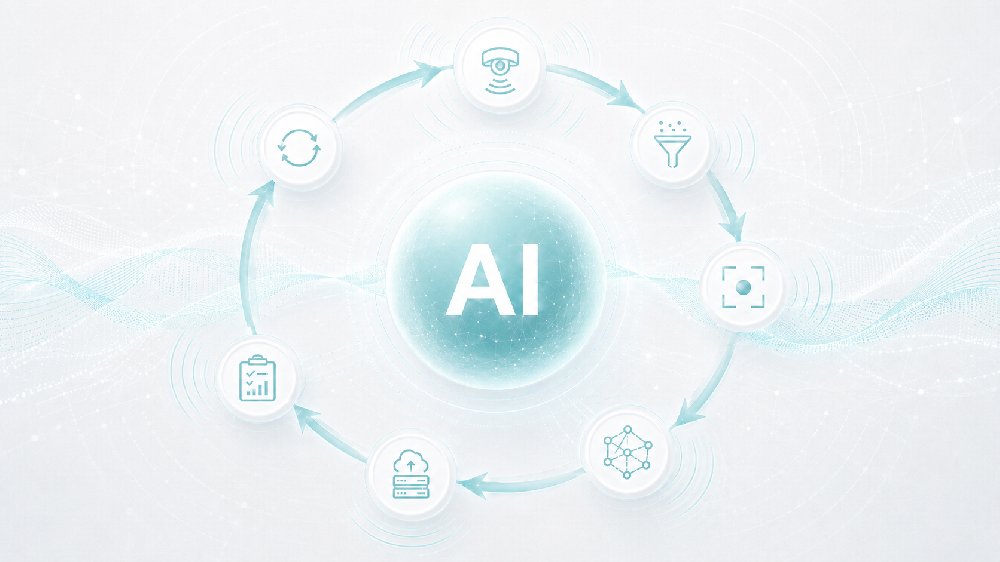
The data can be uploaded to the cloud as training samples, used to continuously improve foundation models, and then redeployed to vehicles through OTA updates, forming a complete closed loop:
Perception → Data Upload → Model Training → OTA Update → Enhanced Perception
As deployment scale grows, the system can continue learning from real-world driving data and build a long-term perception improvement loop.

In the past, the value of millimeter-wave radar was to detect objects.
In the future, its value will be to provide AI with the data needed to understand the physical world.
As end-to-end architectures, foundation models, and centralized computing platforms continue to evolve, perception competition is shifting from sensor stacking toward the reconstruction of the underlying data infrastructure.
The centralized computing architecture represented by InsightRadar is transforming millimeter-wave radar from a target-output device into a core data source for the AI era.
As radar begins to serve foundation models directly, intelligent driving systems will gain a deeper understanding of the physical world.
MAILBOX:
CT@chengtech.net
 Shenzhen company
ADD: 3F-5F, Building C, Chengtou Zhiyuan, No. 37, Cuijing Road, Pingshan District, Shenzhen City
TEL: 0755-23215221
Suzhou company
ADD: No. 7, Suyang Road, Huangdai Town, Xiangcheng District, Suzhou City
TEL: 0512-68359858